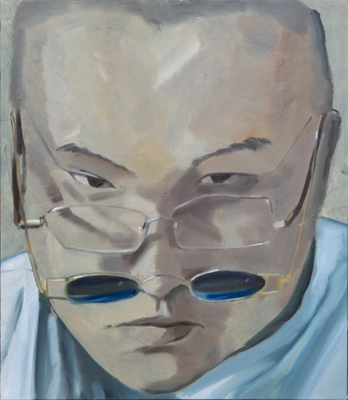
Seungkeun Jang
He explores the ways in which events and objects with fragile qualities are transformed into paintings that project his view of the world. The paintings, created by transferring the shapes of intuitive and impulsive trajectories to the canvas, coloring them, and superimposing sketch lines that go back in time, reflect the site of the artist’s body’s vital encounter with and understanding of the world. The shapes formed by the jagged, impulsive trajectories are glazed and clumsy, but there is a recollected sincerity behind their appearance. The artist creates drawings on the fly, collecting and reinterpreting ideas from objects. He has seen closely or encountered by chance. He perceives the paper or canvas, the support for recording the trajectory, only in his peripheral vision and draws according to the impulsive rhythm of his hand, or he chooses visual isolation, not looking at the support at all. Relying on guesswork and sensation to capture shapes, the recorded objects become the sketches for the paintings, with their fuzzy shapes. Freed from the desire to reproduce the surface of the object, this act aims to truthfully record the indeterminacy and ambiguity of the body’s impulsiveness. The lines thus drawn help me to focus on the abstract fragments of the events encountered and the elements of the painting. The brushstrokes that apply oil pigment to the drawing’s shapes move and lay out the color plane based on the direction of the drawing strokes, such as where they are applied with pressure and the rhythm of the line. In this process, the drawing outline inevitably becomes embedded in the pigment of the oil painting, which is then scratched out again with a pencil or re-emphasized with a darker brush, preserving the past trajectory as a final image. The forms maintained by the dense outlines create the appearance of a solid exoskeleton that blocks intervention from the outside, but the gaps between lines and lines become a fragile exoskeleton that allows for contact with the outside. In Jang’s paintings, the viewer’s gaze is actively invited to penetrate through the gaps in the outline, just as bacteria penetrates through the gaps in an exoskeleton, creating a field of interaction with the artist’s paintings. This phenomenon is not only the artist’s way of being in a world with complex causal relationships, but also the embodiment of the artist’s attitude toward such a world.
News
No news available.