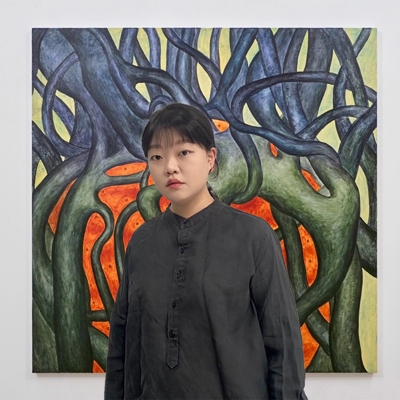
AhHyeon Lee
My studio has long been rooted in Junggu. On the way there, construction sites, vacant lots after demolition, and temporary tarps and partition walls appear again and again. At first I did not think these scenes were connected to my work. They were simply views I passed every day, yet the longer I kept working, the longer those scenes stayed with me, longer than anything on the canvas. I first thought it was about form. The cross-sections of cut structures and the planes made by tarps seemed to echo the relationships between line and plane I was working with on canvas. But that sense could not be explained by resemblance alone. The time during construction stayed with me longer than the finished building, and a vacant lot felt less like an empty place than a site where multiple times and movements had layered and settled. What had already passed and what had yet to be built coexisted, and that state of never resolving into one thing or another simply kept going. Looking back, something similar was happening on my canvases. One line called the next, each layer of paint covered the traces beneath without fully erasing them, and erasure became space for another kind of intervention. Through that process I came to feel that my practice might be less about completing an image than about creating conditions in which the canvas can keep moving. I understand this movement as a verbal attitude in painting, closer to the possibility that the canvas will not settle into a single state and will keep forming new relationships. A construction tarp conceals the interior while revealing that change is underway, and a vacant lot exists as a moment of pause, already holding the shape of what comes next. What kind of structure the sense of transition I noticed there might leave inside painting, and how long a painting can hold another state within it, are the questions I keep returning to. My recent work is moving slowly, holding on to them. Lee Ahhyeon, from the artist’s note
Works


News
No news available.